ChatGPT Wasn't Built for Blueprints: Why General LLMs Fall Short on Construction Docs
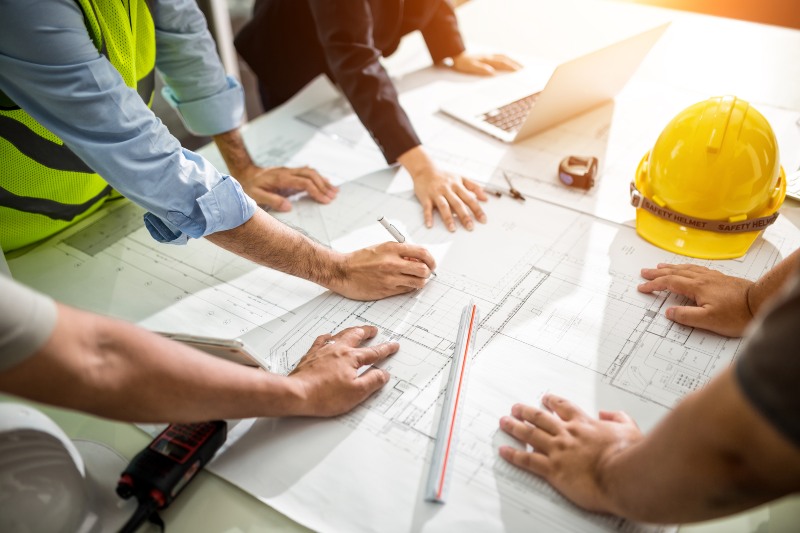
ChatGPT can summarize contracts, explain technical concepts, and answer detailed questions about almost anything. So why can't it do the same for construction drawings?
Because construction document review isn't a language problem.
Ask it what a spec section says and it'll tell you. Ask it to explain a detail and you'll get something reasonable. But that's not what construction teams actually need when they're reviewing a drawing set. They need to know what those documents mean in relation to each other: where the conflicts are, what got missed between disciplines, what's going to cause a problem when work reaches the field.
ChatGPT and general-purpose LLMs weren't built for that kind of cross-document reasoning. That's exactly where they fall short on construction documents.
Why AI for reading construction drawings is a different problem
When you're reviewing drawings before procurement, you're not reading, you're cross-referencing. You're checking whether the fire rating on the architectural plan matches the UL assembly in the specs. You're looking at whether the structural plans are accommodating a condition that is shown on the architectural drawings. You're asking whether the design is actually constructible in the sequence the schedule requires. You're catching the scope gap between two subcontractors that nobody put in writing.
That kind of review isn't a language problem. It requires understanding how dozens of drawings, specifications, details, and schedules fit together. The risk is never in any single document. It's in the relationships between them. And that's a fundamentally different problem from what most AI for document review tools were designed to solve.
General-purpose LLMs process language well. But construction documents function more like interconnected building systems than standalone text. When an LLM encounters gaps, ambiguous symbols, or noisy scanned PDFs from five different firms, it fills in the gaps with information that isn't there.
It's not because they're bad tools. It's because language processing alone doesn't get you to where a project team needs to be.
What 'technically correct' actually costs you
Drawing-to-spec conflicts are one of the most common and expensive issues that show up during construction, and they're a good example of where general-purpose LLMs fall short.
A chatbot might correctly tell you that the specifications call for a PVC membrane roofing system. Technically, that's accurate. But the drawings say 60 mil TPO. One bidder prices one system. Another assumes the other. Nobody catches it because both documents independently appear reasonable.
The real risk isn't whether the AI answered the question correctly. The risk is everything downstream that the system failed to connect. Different manufacturers require different insulation adhesives and attachment methods. Warranty requirements change. Roof drain and flashing details may not work the same way. By the time it surfaces, the team is dealing with re-submittals, warranty disputes, change orders, and potentially rework.
Door hardware conflicts follow the same pattern, with security consequences that compound fast. The door schedule calls out Assa Abloy hardware sets. The specifications require Schlage throughout. Nobody flags it during bidding because a lockset is a lockset. Hardware gets ordered, doors get prepped, frames get fabricated. Then the problems surface: incompatible keying systems unravel the master key plan, electrified hardware won't integrate with the access control system, and lead times diverge by weeks. Every door prepped to the wrong template has to be reworked in the field or sent back to the shop. The result is reordered hardware, modified frames, a security system that can't be commissioned, and occupancy held up waiting on all of it.
That's what makes construction review fundamentally different from traditional document review. Answering questions correctly is not the same thing as helping teams build successfully.
Answering questions isn't enough
The goal of a preconstruction review isn't to answer questions quickly. It's to get to a point where the team can say: we're confident enough to move into procurement and construction, and we didn't miss anything.
A lot of costly project issues happen not because the information wasn't available, but because it was discovered too late, the review process was incomplete, or the team didn't have confidence that all the critical checks had been performed. That's not an information problem. It's a coordination and risk-management problem.
The real opportunity for AI tools for general contractors and project teams is AI that works the way experienced teams already work, not just AI that answers questions faster:
Automatically identifying risks: drawing-to-spec mismatches, trade coordination clashes, constructability and sequencing issues, scope gaps between subcontractors, before they become procurement problems or field conflicts.
Preparing the work: automatically drafting the coordination checklists, RFI logs, and submittal registers teams need to run a complete review. The biggest operational value isn't faster answers. It's preparing a first draft of the tedious work so teams can focus on resolving issues rather than building the process from scratch.
Moving forward with confidence: that the review process was complete, that critical problems were not missed, and that the team is ready to move into procurement and construction without costly surprises later. That confidence is something teams have to earn through the process. AI should be helping them get there faster.
None of that is something a general-purpose LLM was designed to deliver. The goal isn't a smarter search bar. It's helping teams move into procurement and construction knowing they didn't miss anything.
General-purpose AI reads documents. AI purpose-built for construction understands how they connect. That's the difference between a review that's fast and one that's actually complete.
Related articles

Primepoint Raises $10M to Scale Construction Intelligence Platform

He Chose the Hardest Industry | A Conversation With Lubomir Bourdev